Investigative Study

Investigative Study is the search activity that is characterized by being reflexive, systematic and methodical; Its purpose is to obtain knowledge and solve scientific, philosophical or empirical-technical problems, and it is developed through a process.
Week1 (18/09/2018)
What is Research?
It is a human activity aimed at obtaining new knowledge and, in this way, occasionally give solutions to problems and answer questions, which in this case is about the VFX industry.
The steps to follow are:
-Finding Reading Material
-Contact the librarian for assistance if needed
-Think to research in different places such as; Online (E-Books or E-Journals)
-Also, recommended to do a Mind Mapping (Bubbl.us)
Week2 (27/09/2018)
Why Research is important?
- To understand how to analyze and how to share information
- To learn something new or something that was not known
Writing the Proposal
The proposal should be focused in the are that interest me (VFX). Regarding the research methods, is recommend to do it in Secondary Research (Documents, Autobiographies or Books).
Week3 (02/10/2018)
Breaking Down the Writing:
-Introduction: Summarise what the writing is about. 400 Words
-Main Body: Understanding the content and evidence to support the writing. 2.500 Words
-Conclusion: Suggestions. 400 Words
Annotated Bibliography:
-Citations
-Author (Surname and Initial)
-Date
-Publisher
-Country
-Page number
-Accessed
Task; 300 words about current TRENDS in VFX:
Current Trend in VFX
(3D Simulation)
The simulation might be defined as experimentation with a model that replicate aspects of the real world. This allows us to work in the same conditions as reality, but of course with controlled variables in an environment that is artificially created.
The purpose of VFX Simulation is to make able to manipulate or test the behavior of a person and thing before placing in the real environment.
For example, the simulation of a hotel building is very useful for architects, as it will allow to test any new idea inside the hotel or just solve any issue before building the hotel itself.
The technique of Building simulation was considered as a separate discipline starting around the 1970s. It used to be done on paper and with scale models, but nowadays the correct 3D Software is likely to be used by architects and designers to make a virtual version of the building and then simulate real-world factors such as light, energy consumption and also to evaluate green solution from solar panels.
In terms of safety, a clear example is the BIM software (Building Information Modelling), that allows having a clear visualization in 3D of a building designed and therefore manage the fire safety, this could be, the time needed to evacuate the building in case of fire and also, calculate if the route and distance of the fire escape is acceptable and secured.
Overall, the 3D Building simulation is considered a potential path to follow in order to build a solid, safe, comfortable and of course a GREEN building.
Bibliography
-Ali M. Malkawi , Advanced Building Simulation, New York, US, Taylor & Francis e-Library,2003.
-Miroslaw J. Skibniewski, Automation in Construction, https://www.sciencedirect.com/science/article/pii/S0926580515000205
-Autodesk: https://www.autodesk.com/solutions/bim
Week4 (09/10/2018)
Critical Analysis
It is the capacity to be objective, rational and analytical about subjects, situations and problems. In terms of the process, there are three steps to follow:
-Description: What?, Where?, Who? and When?
-Analysis: How?, Why? and What if? -
-Evaluation: So what? and What next?
Annotated Biography
Consists of an organised reference list, followed by a short description and evaluation of an article.
Generally consists of two parts: Part 1( a list of books, articles and documents) and Part 2 ( each item in the list is followed by annotation).
Task: 500 words of five Annotated Biography
Books;
1 - Berys Gaut, A Philosophy of Cinema Art, US, 2010
This book examines in details the philosophy of cinema, explaining how the medium conditions fundamental features of cinematic artworks. Berys discuss relevant information about the audience's emotional responses, character identification, the digital cinema, films as a language and the most important part that the major project is focused on realism in cinema. The book includes examples of; Moving image technologies such as Soviet Montage (traditional editing), Realism in digital cinema: Gollum (Lord of The Rings) and King Kong (2005).
2- Jon Gress, Visual Effects and Compositing, US, 2014
Jon's book contains an informative and helpful guide to help beginners to reach the knowledge level of a professional in visual effects artist, starting from a solid understanding of the basics to become a skilled artist in this field. It includes detailed information on 2D and 3D motion tracking and matchmoving, as well as extraction, composition and cutting-edge Visual effects technologies. The author provides useful photographs explaining what should be done in order to obtain a great result.
3- Pamela Glintenkamp, Industrial Light & Magic: The Art of Innovation, US, 2011
Industrial Light and Magic is a company founded by Gorge Lucas in 1965. The Art of Innovation is the first and only book to focus on the Gorge's company work during the last six years, explaining the technological innovations for the films and its creativity. The book includes more than 400 images from many films such as Star Wars, Transformers, and Iron Man.
4- Jahirul Amin, Beginner's Guide to Character Creation in Maya,......., 2015
Article:
5- Mike Seymour, Art of Tracking Part 1: History of Tracking, US, 2004, Available at https://www.fxguide.com/featured/art_of_tracking_part_1_history_of_tracking/
(Accessed: 10/10/2018)
This article details the history of visual effects in the field of 2D and 3D tracking, with information from the first tracking that was used in a missile by the US Defense Department to the improvement on the track tool in After Effects in 2003. The writer also, highlights where the 3D tracking system was used specifying its software. Mike's article provides dates and some photographs to allow this article to be more understandable.
Week5 (16/10/2018)
Resources given by Katie in the Mollie Caly room
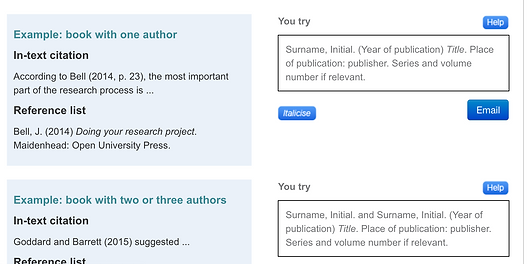
-Harvard Cite Them Right

The Cite them right software makes it easier to reference the sources that matter to any student or person involved with books, therefore it expands the frontiers of academic discourse.
-ZoteroBib

Zoterobib is another potential reference software which manages bibliographic data and related research materials.
Proposal (500 words)
Assignment 1 (19/10/2018)
Comparing and Contrasting examples of a creature moving in water
As the title highlights, the research topic will be the comparing and contrasting examples of a creature moving in water. Audiences watch a realistic aquatic CGI creature through a film or advertisements that sometimes interact with real animals or humans but, audiences do not know, sometimes, what process is needed to simulate such a believable scene. For instance, when Angelina Jolie in one of her films, punches in the shark’s face and then rides to the surface or interacts with the shark (1), audiences might believe it is a trained shark as the sequence seems realistic.
Therefore, the aim of the research will be focused on providing formation about why an aquatic 3D CGI animated creature is successful and the other less so, covering and highlighting as much information as possible, in particular, when bringing to “live” a CGI creature with; believable movements (involving water and the creature), lighting (shadow in water and luminosity on the creature), texture (water and the creature skin) and colour (environment and the creature). These important sections in addition with the 12 principles of animation developed by Walt Disney Studios (2) will help to increase the knowledge about animation and also to understand how to approach in the creation of an aquatic CGI creature in the best result as possible.
In order to procedure bringing the information of each key section mentioned above, secondary research will be done through articles, books, e-journal, e-books and data collected from previous researchers.
For example, the creation of realistic CGI dolphin movements for the film Dolphin Tale 2, the camera team recorded plenty shots of real dolphins in their habitat, that later in post-production were placed in frames with the CGI dolphins with the purpose to obtain their aquatic performance accurate (2). In the same way, the animation of any creatures that exist, it is meant to follow the rule of studying their living in its environment in order to re-create how they move, behave and sometimes how it interacts with humans.
The outcome of the research will provide the analysis of successful and unsuccessful aquatic CGI creatures and also will mention how accurate and realistic it has to be in terms to deliver a great result and not breaking the illusion of the audience while watching a perfect animation of a CGI creature in a film. Therefore, it is expected to provide an extensive information that can be clearly understood and applied in different environments involving animated water and CGI creatures in order to support with any issue that may arise within the composition and animation area.
Bibliography
1.Lara Croft Tomb Raider: The Cradle of Life (2003)
2.Principles of Animation. http://minyos.its.rmit.edu.au/aim/a_notes/anim_principles.html. Accessed 17 Oct. 2018.
3.Computer Graphics World - ‘Dolphin Tale 2’ VFX. http://www.cgw.com/Press-Center/Web-Exclusives/2014/A- Spin-on-Effects-for-Dolphin-Tale-2.aspx. Accessed 17 Oct. 2018.
Proposal, Mind Map

Week6 (23/10/2018)
Structure (Mind-Map)
A mind map is an easy way to brainstorm thoughts organically without worrying about order and structure. It allows creating a diagram for representing tasks or concepts.
Proposal - Structure

Week7 (30/10/2018)
Investigative Study structure will be following the same paths as the Proposal structure because breaking in parts the research will help the reader and the researcher to understand clearly the parts of the investigative research.

Week8 (06/11/2018)
Critical Reflection and Evaluating Arguments
-Critical Reflection is a reasoning process in terms of descriptive, analytical and critical. Critical reflection can be presented in a different ways such as written form, orally and artistic expression.
-Evaluating Arguments is the evaluation of examples, logical reason and evidence of people opinions and beliefs. Normally to evaluate an argument, it is recommended to follow some rules; Identify the conclusion and the premises, put the argument in stand form, decide if the argument is deductive or non- deductive and make the final judgment (whether is good or bad).

Week9 (13/11/2018)
Research
In this session, it is highly recommended to begins the investigative writing of the topic chosen for the final project.
Once the structure is already done, the writing shall be easy to begin with at least two main point to discuss.
-The structure is basically an outline of the work expected to provide the research structure towards the end of introduction of the dissertation, also to have a clear idea in how to being the writing and the order it has to be.

Week10 (20/11/2018)
Piece of the Investigative Study
Here it is a draft of the Introduction about my Investigative Study about Successful and Unsuccessful CGI Aquatic creatures moving in water
-Introduction (Draft)
This investigative study will be focused to explore and explain in depth, the comparation and contrasting of an aquatic creature with the purpose to learn and understand of how a Computer-Generated Imagery (CGI) creature that moves in water is successful and the other less so.
Therefore, once the methods and techniques that were carried out to achieve successful creatures and those methods and techniques that did not allow other CGI creatures to reach the same level of success are explored and explained, the understanding of creating a CGI will be clear and more effective, because those methods and techniques could be used and applied in different projects such as; films and adverts in order to create successful aquatic CGI creatures.
It is understood that the modelling is not only the most important part in CGI, but the texture, colour, light and movement would be the techniques, that will definitely support the end result in a potential way of achieving a realistic CGI aquatic creature. For example; the recreation of water splash in Moana’s film, the VFX artist used the fluid simulation technique accented with splashes, along with another fluid simulation inside the animated water adding a plastic being shaken until bubbles formed.
The comparison and contrasting will be explained by the analysis of multiples film shots that contains one or two CGI aquatic creature in it. Therefore, film books, e-Books, VFX e-Journal and film director articles are the resources that will support the argument about the analysis.
The poof of some decent references will make the reader find it more believable in what the analysis will say and also will help the writer to highlight the facts of successful and unsuccessful CGI aquatic creature achievements.
It is calculated that around five books and two articles are needed with the purpose of collecting all the necessary information for this investigative study.
Film directors avoid giving any explanation when they created an unsuccessful material such CGI creature but, proudly explain when it was successful. So, with the majority of successful 3D creature’s information the analysis will be provided with an extensive documentation covering the two sides (successful and unsuccessful of CGI aquatic creatures) because, in general, once it is known how a great CGI achievement was done, the knowledge of CGI process increases and will be much easier to highlight and analyse why the other CGI was not a great achievement.
Week11 (27/11/2018)
Piece of the Investigative Study
Here it is a draft of the Main Body about my Investigative Study about Successful and Unsuccessful CGI Aquatic creatures moving in water
-Main Body (Draft)
A successful CGI creature moving in water means that the hard-work behind of a project was successfully achieved by applying visual effects methods, following video techniques and working hand to hand with real environment and virtual environment.
The animation effect for a CGI creature helps to connect a creature to the environment. Attention to details is especially important and useful when working for a realistic style, and essential when adding animation to live action. The key factors that make the CGI creature feel more realistic are; substance, fluidity and weight with the purpose to connect the creature with any environment. For example; a CGI creature making water splashes, consist in the water gravity that goes up and then down creating foam therefore, weight helps to break into the water and fluidity defines the shape characteristic at each stage.
The film, Dolphin Tale 2 directed by Charles Martin Smith, created 3D dolphins with the purpose to animate their water performance, that meant the VFX team had to create water simulation, splash and reflection following the key factors mentioned above in order to obtain their work invisible and photoreal (2).
Another example is the CGI water in the James Cameron Titanic film, where Robert Legato (VFX supervisor) did not know how it could be done by that time (1997), but he knew for sure that the creation of CGI water was possible. Legato took the decision to photograph a ship at the sea with the purpose of capturing the water behaviour in contact with the ship in movement, this technique helped Legato to achieve a great water fluid and simulation in contact with an object (Ship).
Therefore, having many sources will always help to obtain a great end CGI result, for example; watching hours of documentaries, interact with aquatic creatures (dolphins or fishes) and being accessible to have some image references.
“Creating CGI look real is typically only half the battle, we have to emotionally connect the audiences with what is on the screen” Robert Legato (3).
For a great performance in terms of texture and lighting of CGI aquatic creature moving in water, VFX artist normally visit an aquatic creature environment with the idea to understand how the aquatic creature skin behaves and respond to water. For example; wet skin serves as a sunblock and it affects the water dispersion producing distinctive light effects.
In the film Shape of Water (2017), Guillermo Del Toro did not want a digital creature for his film so, Del Toro’s team built a blend of prosthetics, make-up and digital enhancement because having variety of colours on the creature texture looked more realistic as texture has no solid colours. Also, to understand how the light behaves on a non-existent CGI creature, VFX artist built a model to create a three-dimensional image that helped to observe how the light would catch and impact on the creature.
Week12 (04/12/2018)
Piece of the Investigative Study
Here it is the second draft of the Main Body about my Investigative Study about Successful and Unsuccessful CGI Aquatic creatures moving in water
-Main Body (Draft)
“We assumed the glow would not be the same as a digital glow. So, the maquette was placed under a light and rotated so we could understand and see where to change the material” Guillermo Del Toro (4).
But, having a model to observe how the light behaves on a non- existent CGI creature was not necessary in the 80’s. For example; in The Abyss film (1989), James Cameron had nine VFX facilities working in his film project with Gorge Lucas’ ILM company assuming the majority of the VFX work, which designed a program that could simulate the watery beast-tube-thing with incredible realism according to Ian Failes (2015, p. 16-17). Pamela Glintenkamp (2011, p. 24) mentioned that the whole process took more than six months, because it had to be simulated the light impact, the light reflections and be photographed from every angle so the effects could be composited onto live action.
Colour correction is also the key factor for a successful CGI creature, as it is the process of adjusting the colour profile of each scene to meet a unified and consistent look. In addition, colour grading is stablished for the creative look of a film after all the visual effects are completed. For example; since Steven Spielberg brought the white terror in 1975 with his great shark in the film Jaws, nowadays there are plenty of shark’s films around the world, specially The Shallow film released in 2016.
Jaume Collet-Serra, the director of The Shallow film, mentioned that some sequences were complex to make it, because the weather changed constantly and water changed colour which made difficult the post-production process in the application of colour correction on the CGI shark and water (6). Therefore, to obtain the colour information, Jaume’s team created different physical elements (fin and tail) that they could interact with the water and with the actress, and then replace those things with CGI. In this way, the VFX artists had the possibility to analyse how the sunlight affected the creature and the water in order to deliver realistic CGI material with live action in terms of colour correction and colour grading.
The special effect technician Lino Stavole mentioned that the best CGI creature artists are typically able to think in two different ways. Stavole explained his theory with an example of two mindset living in different planets; One CGI creature artist thinks about anatomy, physiology, biology and physics, and the second CGI artist thinks about pictures, sculptures and video footage as reference.
On the other hand, there are CGI creatures moving in water that did not meet the level of realism in terms of colour, texture, movement and light within a live action footage.
Normally, technology is pointed as issue when an aquatic CGI creature is not great as the film director or audiences expected.
Week13 (11/12/2018)
Piece of the Investigative Study
Here it is the third draft of the Main Body about my Investigative Study about Successful and Unsuccessful CGI Aquatic creatures moving in water
-Main Body (Draft)
The film industry understands that technology and money are needed for many things in a project film, especially in the Visual Effect department where computer machines and VFX software’s play an important role in terms of complex shading, rendering of skin, Motion Capture (Mo-cap), composition and simulations. But, the film industry also know that it does not take money to create a great shape of creature or simulation, it is talent. For example; a dolphin shaped like a dolphin, will only take couple of hours or days for a VFX department to achieve a decent result, only of course if they know how a dolphin looks like.
VFX companies know that the process of creating an CGI aquatic creature could be complex sometimes because of the way it works; the film director asks to the art design team to draw up 2-D drawings of the chosen creature, later the modelers team receive the drawings of the creature, who then sculpt it in 3D CGI on the computers and delivery it to the composition team for texturing, colouring, lighting and finally, to place the 3D CGI creature in the live action footage making it to look as real as possible.
But, sometimes films face unsuccessful CGI creatures in its productions, for example; in 1996, the film, Scape from L.A directed by John Carpenter, had a budget of fifty million dollars with the visual effect company called Buena Vista Visual Effect, which unfortunately created an unsuccessful CGI shark and CGI water simulation. In the film, the shark appeared behind a rock for a couple of seconds under the ocean but it was enough to observe the lack of correct texture, lighting or colour applied on the CGI. It made the shark looked unrealistic, even the water simulations did not fluid correctly when the submarine moved towards the Universal Studios building. John Carpenter said that this film, Escape from L.A. was released at the time where computer graphics were still in their relative infancy, and his CGI shark were frankly cartoonist.
The VFX Producer, Thomas Horton, highlight that lighting is probably the most critical and complex process when creating a photo-realistic CGI environment, for example; an ocean. Because, in the real world, the way the light from the sun bounces or reflect off on various surfaces in the ocean has an impact on the overall ambience. Therefore, could be very challenging and time-consuming replicate that with CGI nowadays, but not impossible.
Horton also mentioned that, while computers can help to create the impossible seem possible, it is best to stick with practical approach when it comes to shooting like explosions, fires and even architecture because all could come down to a phenomenon that we cannot even touch: Light.
Week14 (18/12/2018)
Piece of the Investigative Study
Here it is the fourth draft of the Main Body about my Investigative Study about Successful and Unsuccessful CGI Aquatic creatures moving in water
-Main Body (Draft)
The VFX Producer, Thomas Horton, highlight that lighting is probably the most critical and complex process when creating a photorealistic CGI environment, for example; an ocean. Because, in the real world, the way the light from the sun bounces or reflect off on various surfaces in the ocean has an impact on the overall ambience. Therefore, could be very challenging and time-consuming replicate that with CGI nowadays, but not impossible.
Horton also mentioned that, while computers can help to create the impossible seem possible, it is best to stick with practical approach when it comes to shooting like explosions, fires and even architecture because all could come down to a phenomenon that we cannot even touch: Light.
Another example of unsuccessful CGI aquatic creature is the Crocodile film directed by Tobe Hooper in 2000. In this film, the VFX department brought to life the creature through four primary methods: Creature vision which is when the camera assumes the point-of-view of the creature, Fiberglass prop that is a replica of real crocodile floating in the water but otherwise seems immobile, Set of jaws which is seemingly without eyes and capable of chomping actors and of course an CGI (Computer Generated Imagery). But, these methods did not have much success in order to deliver a believable crocodile because, the CGI did not even appear to occupy the same reality as the human characters and also some basic VFX work was not applied on the CGI crocodile correctly such as; lighting, animation, colour and texture.
Therefore, if one of the other key factors which is Animation is not followed correctly, the end result of a CGI creature in any film will be unsuccessful. Because, CGI creature will have no live, no expression and unable to provide their best work to the audiences.
The American animators Ollie Johnston and Frank Thomas who worked in The Wald Disney Company for about forty years, did write the twelve principles of animation in a book called The Illusion of Life. This book brought the understanding of how the VFX artists and animators make us to believe that CGI creatures or things they have rendered are actually alive creating an illusion between the audience and the animated CGI creature. Ollie Johnston and Frank Thomas explained the 12 principles as;
-
Squash and Stretch giving the illusion of weight and volume to a character as they move.
-
is used to let the audience know that a major action is about to take place.
-
helps stablish mood, create focus and clarify what is happening in the scene.
-
Straight ahead and pose to pose refers to the technique of drawing each pose, one right after another and also refers to the animation technique in which key frames are planned ahead of each other.
-
Follow through and overlapping action means action and stop (character runs, their main body stops, but the other parts keep moving for a bit after).
-
Slow-in and slow-out is designed to add realism to the movement of character.
-
refers that almost all actions in life have a slightly circular motion.
-
Secondary action is an additional action that reinforces and adds more dimensions to the main action.
-
Timing helps create the illusion that an action is abiding by the laws of physics.
-
is all about overstating certain movements in a way that helps evoke a point, yet does not ruin the believability of the scene.
-
Solid drawings encourage animators to be mindful of the fact that while forms may be presented in 2D, they shall strive to look 3D.
-
posits that animators shall strive to create images that will be interesting and compelling to audiences.
Ollie and Frank also mentioned that there is a clear difference between human character animation and motion design but, the twelve principles are still applicable across these processes as it makes the character or CGI creatures believable. If no animation is applied to a CGI character, the end result will have no meaning and most importantly, no connection with the audiences.
-Conclusion
All the information obtained for this investigative study about successful and unsuccessful CGI aquatic creature in terms of Visual Effects Techniques (VFX), methods, lighting, animation texture, technology and colour correction will potentially help to create a CGI dolphin and water simulation for the University final project. According to VFX artists, modelling or animating a CGI character or creature is not enough for a great end result, but having contact with the aquatic creatures, which in this case are dolphins or having some references of them as documentaries or images, will always help to observe how the dolphin behaves in contact with water. VFX artist strongly suggest to use this method because, it will make us to understand the impact of the light on the dolphin skin when is wet or dry, notice how the texture might change when the dolphin is underwater or jumping out from the water and also how to animate a CGI creature applying the twelve principles of animation written by the two animators from The Wald Disney Company.
Regarding CGI and VFX technology, we understand that VFX technology has been changing for better since Titanic film came out successfully with its CGI water and colour correction in 1997. Nowadays, the latest film with great CGI technology is The Meg, having CGI water and CGI shark.
Vince Baertsoen who is the group CG Director at The Mill said that is not always easy to implement new technology to work faster and more efficiently. It just takes time, and we need new skills sets and developers to do this integration. VFX is about looking for solutions.
For example, in The Meg film directed by Jon Turteltaub in 2018. The VFX animators created a CGI Megalodon shark in record time, with lifelike accuracy from the way the shark moves in the water to its muscles and skin using Ziva VFX software and of course using some of the twelve principles of animation such as Arc, Anticipation, Timing and Slow-in and Slow-out.
Stephan Trojansky who is the president and VFX supervisor in Scanline, mentioned that having the correct computer system will help to tackle time while rendering CGI creatures. For example; Stephan said that years ago they would probably have needed a huge render farm and a large crew for a very small amount of footage for any kind of CGI, but nowadays they can use around 2,500 Intel Xenon processors with almost 100,00 cores which were used to compute all of the needs of the film The Meg. This means, a part from having great a GCI aquatic creature animated, textured or colour corrected, it is important to count with a faster computer system in order to speed the rendering and achieve the best high resolution. The head of AI Marketing in Intel said that, at Intel, they strive every day to make the amazing possible, and it’s exciting to see the end result.
In other words, understanding why is important to use the VFX technology we are having now such as Mo-cap System or Sophisticated CGI software’s, as well as the importance of adding lighting, colour correction and animation for a CGI creature will help to achieve a great end result. Because, with the lack and limited reference images, VFX technology and information about CGI in the 90’s, film directors tried their best to create a CGI creature and water simulation, but some of them unsuccessful.
Week15 (08/01/2019)
Final tittle
Comparing Successful and Unsuccessful CGI Mammal creature moving in water, and explaining the contrasting of different lighting, colour, animation and technology.
References
-Hurst, Adriene. . https://www.digitalmediaworld.tv/in-depth/399-spin-vfx-makes-a-splash-with-water-light-creature-fx-for-dolphin-tale-2. Accessed 29 Oct. 2018.
-Failes, Ian. . Roly Allen, 2015 (pages 98-99).
-Creature Feature: ‘The Shape of Water’ | Computer Graphics World. http://www.cgw.com/Press-Center/In-Focus/2018/Creature-Feature-The-Shape-of-Water.aspx. Accessed 30 Oct. 2018.
-Lighting the Abyss: Lighting Design + Application ReprintOctober 1989 | Hydroflex. http://hydroflex.com/lighting-the-abyss/ . Accessed 12 Nov. 2018.
-‘Shark Films: Is Jaume Collet-Serra’s The Shallows Jaws for Millennials?’ , 9 Aug. 2016, http://www.independent.co.uk/arts-entertainment/films/the-shallows-jaume-collet-serra-on-making-the-first-big-shark-film-since-jaws-and-working-with-a7181041.html .Accessed 31 October. 2018.
-Failes, I. (2015) Master of FX. London UK: Roly Allen. p, 16-17.
-Glintenkamp, P. (2011) Industrial Light & Magic the art of innovation. New York, NY: Abrams. p, 24.
-Thomas, F. (1997) The Illusion of Life, Disney Animation. Hyperon. p, 47-69